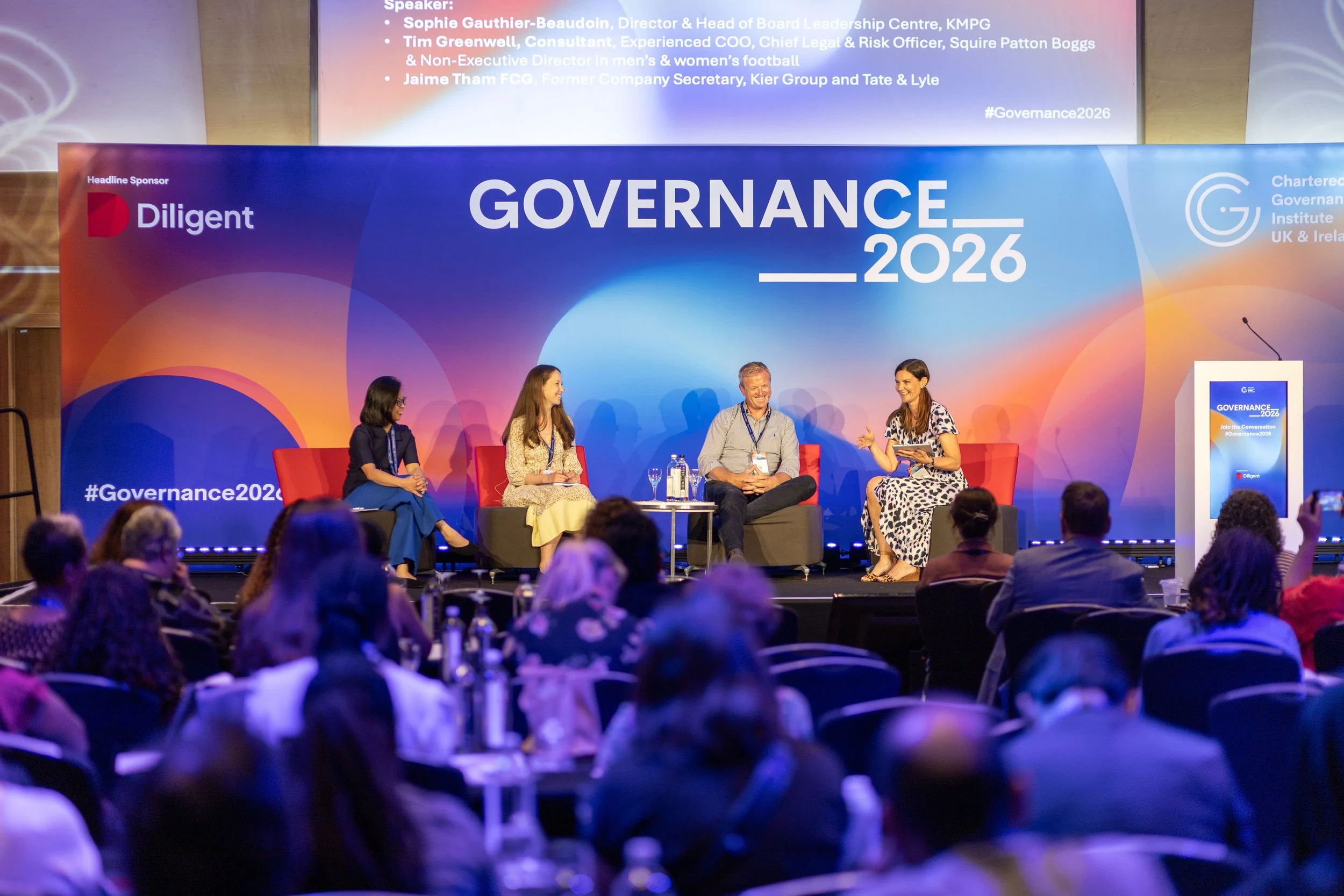
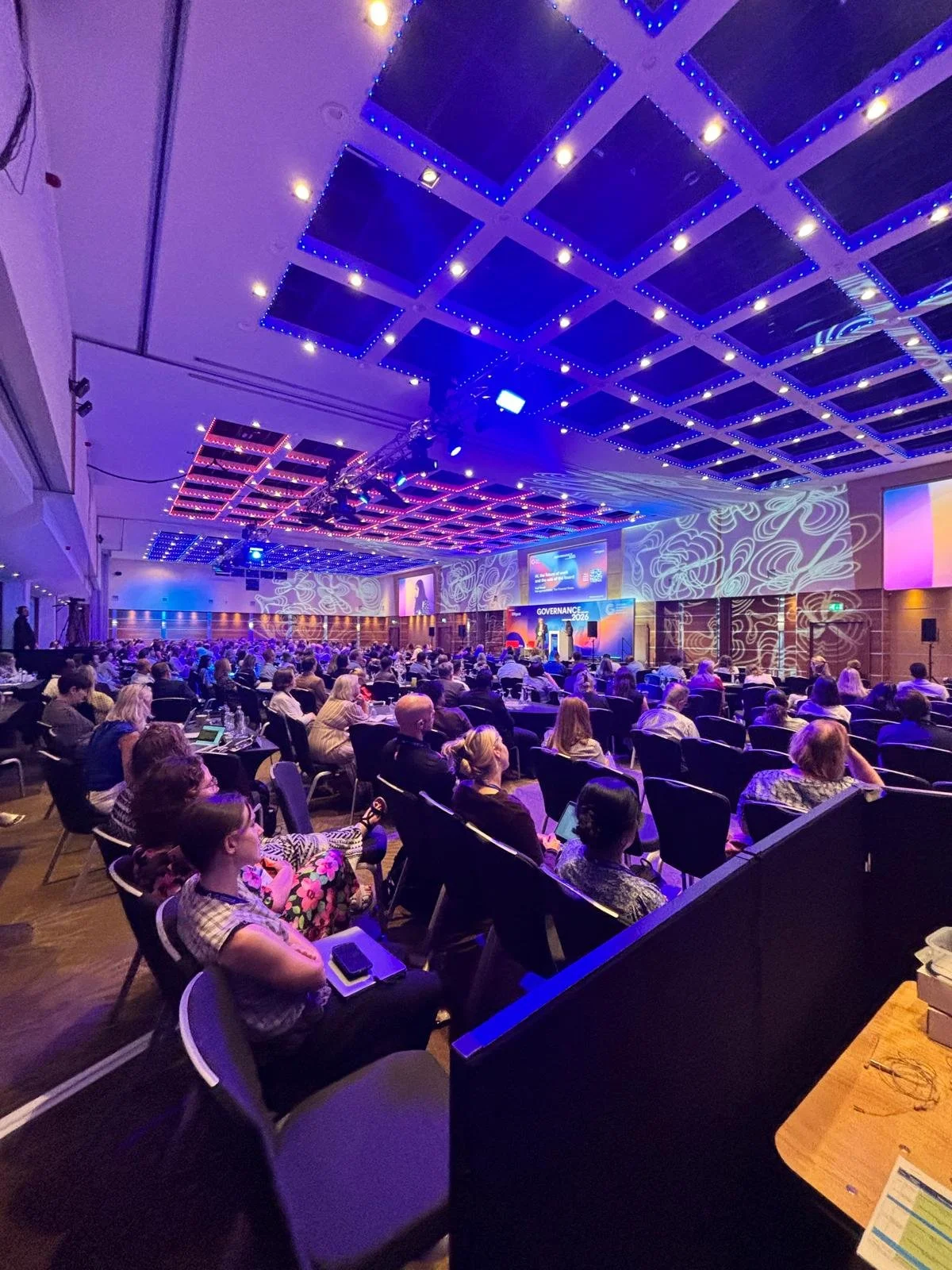
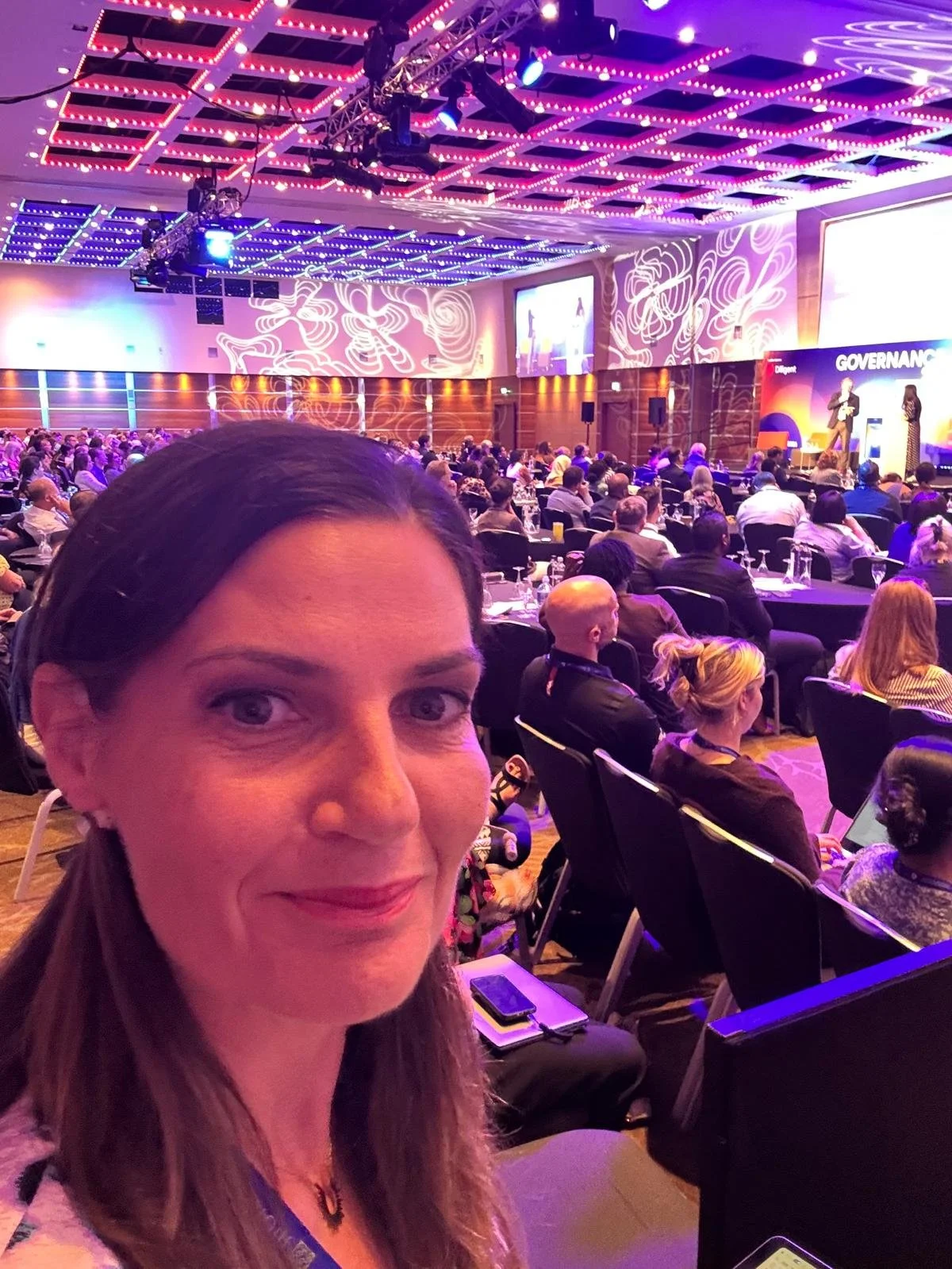
Two days, 13-plus sessions, and one theme kept resurfacing wherever I went: the governance function is being asked to do more, with less certainty, in less time - and our profession is rising to meet it.
CGI CONFERENCE 2026 -Thoughts from Kerry

What struck me most was that conversations on topics as varied as takeover readiness, AI adoption, board evaluations, and the failure to prevent fraud offence, kept landing on the same underlying question: are we asking the right questions, and are we actually listening to the answers? Blind spots are rarely things nobody knows; they're the things we've quietly stopped querying.
AI was everywhere, and rightly so, but the tone has shifted. This wasn't hype-chasing; it was leadership and governance framing: validation, oversight, and asking what problem we're actually trying to solve before we reach for the tool.
I was also struck by how much energy there was around elevating our own profession, by being louder about the value governance professionals bring, investing properly in the next generation, and being honest about a Governance Market Survey that tells us workload is growing faster than resource.
If there's one takeaway I'd bottle from the whole two days, it's this: preparation beats reaction, every time. Whether that's a takeover defence manual, a succession plan for extended leave, or simply asking one hard question at your next board meeting that nobody's got round to asking yet.
We hope you find value in our collective notes below!
Kerry
Day 1
The RGS team thoroughly enjoyed attending day 1 of the CGIUKI Conference earlier this month. It was a great opportunity to network with peers familiar and new, and a chance to listen to some fabulous speakers across a range of interesting topics.
For those who couldn’t attend, or anyone curious about the highlights, we've put together a summary of key takeaways from the sessions we joined. As it wasn't possible for us to attend every session, this is not a complete record of the conference, just the sessions our team was able to get to.
A world in flux
Derek Leatherdale, Senior Geopolitical Risk Adviser, Sibyline
A fascinating update on the global political tensions impacting UK companies and organisations. As well as discussing the latest developments in the Russia v Ukraine war and the USA v Iran conflict, Derek provided an insightful update on the situation in Taiwan and the impact that Chinese politics is having around the globe.
Key takeaways:
The regional updates issued by the FCO are an important source of information.
Boards and geopolitical risks – Impact assessments. How are they actually impacted?
Forward-looking geopolitical risk assessment is as much an art as it is science.
If you try and project forward and you’re only 60% right, it’s better than not having planned at all.
RGS suggested action: Add geopolitical risk as a standing board agenda item and task management with producing a quarterly impact assessment against the FCO's regional updates.
Ethics in cybersecurity
George Quicley, Head of ICA, IASME
A technical and practical update focusing on the importance of Cyber Resilience, as well as Cyber Security. George clearly explained the different assurance systems available, and the differing standards (ISO27001, Iasme Cyber Assurance, the Cyber Essentials NCSC scheme) and codes of practice which organisations may wish to refer to whilst building up their cyber resilience and related policies and processes.
In practical terms, cyber risk should be placed at board-level and governance teams should ensure an asset register is being maintained. If they haven’t already, organisations should carry out Cyber Security Vulnerability Audits and Cyber Security Strategies should be reviewed on a regular basis. Business Continuity Plans must include cyber security.
Key takeaways:
Cyber Governance Code of Practice is free to download.
Geopolitical risks can be highlighted in the board room through more visible impact assessments and tools like scenario analysis.
RGS suggested action: Download the free Cyber Governance Code of Practice and keep a live asset register on the board's risk register.
The co sec function – fit for the future
Tracey Brady, Vice President, Diligent
An inspiring presentation by Tracey on how company secretaries can play a role in preserving accountability and defensibility in an increasingly automated environment. As more processes become automated, the company secretary role will evolve to be less about producing data and documents, and more about validation and oversight.
Tracey urged the audience to not get sucked in to the “AI Hype” and to keep challenging and scrutinising the assumption that introducing AI will automatically deliver efficiencies. Instead, Tracey recommended Co Secs focus on asking three fundamental questions: what problem is AI attempting to solve, why is it needed and what is its carbon footprint? In the long term, companies will need to account for both the financial and non-financial costs of implementation.
AI Governance is very much a leadership issue.
Key takeaways:
Just with any other business decision, the adoption of AI must be grounded in a solid business case and the value of implementation should be proven before a company commits.
Leverage the in-person connector role of the Cosec.
RGS suggested action: Build a short AI business case template (problem, cost/benefit, carbon footprint) that any proposed AI tool must pass before Co Sec sign-off.
CGI research update: governance in the modern world
Peter Swabey FCG, Policy & Research Director, The Chartered Governance Institute
Kayla Schembri, Head of Policy, The Chartered Governance Institute
Dr Valentina Dotto, Policy Adviser, The Chartered Governance Institute
"What happens when director, trustee or public appointee needs to step away from their role for
an extended period?"
What surprised us most was that there didn't seem to be an obvious or straightforward answer. Thanks to Valentina Dotto PhD for raising the question and for her determination to explore practical solutions. Too often, stepping down from a board can be seen as the only viable option, which has wider implications for trustee recruitment, retention and board diversity.
A thought-provoking discussion about the continuous responsibility of office-holders during parental or other leave. Whilst it is possible to delegate functions and powers, the liability will remain with the office-holder.
The panel discussed practical steps which could be taken to mitigate risks in this situation. These included formally recognising the temporary absence. This would create a defined, time-bound status with clear allocations of responsibilities.
Key takeaways:
CGIUKI research reveals trustees, directors and office-holders often remain legally liable for decisions made during their absence, with no clear framework for managing responsibilities on extended leave.
Charities are especially exposed, as they typically lack the governance teams or succession arrangements larger organisations rely on, sometimes pushing trustees to resign rather than take leave.
CGIUKI is calling for clearer legal and regulatory guidance, with longer-term reforms to company and charity governance frameworks to give trustees and directors greater certainty.
RGS suggested action: Draft and adopt a “temporary absence” policy that formally defines delegated authority, time limits and reporting lines when an office-holder is on extended leave. This doesn’t deal with the legal obligations, but it’s a step in the right direction.
For more on this research: www.cgi.org.uk/about-us/cgi-news/2026/legal-uncertainty-during-maternity-and-long-term-leave-creates-risks-for-trustees-and-directors-warns-chartered-governance-institute/
Elevating the governance profession
Joshua Domb, Founder and Managing Partner, Gen-R Law
Kayla Schembri, Head of Policy, The Chartered Governance Institute
Joshua and Kayla brought the sexy back to co sec and outlined the key impact that governance professionals have in ensuring the success and meaningful development of their organisations through a thought-provoking and innovative approach.
Key takeaways:
Joshua and Kayla delivered a lively, well-received presentation, reframing governance as bold, impactful and worth celebrating rather than a quiet background function.
The talk championed governance professionals to be more vocal about their critical role in building successful, well-run businesses that contribute positively to society.
The session clearly struck a chord with attendees, sparking plenty of smiles, playful banter and memorable conversation starters throughout the day.
RGS suggested action: Take five minutes after your next board meeting to write down one decision or outcome that wouldn't have happened without you in the room — and own it. Building this into a habit (even a private running list) will help you recognise your own strategic value and over time, will be a powerful reminder that the Co Sec’s role extends far beyond administration.
Getting the most out of your internal board evaluations
Laura Higgins FCG, The CoSec Coach
Claire Phillips ACG, Head of Corporate Governance – Insurance, Wealth & Retirement, Aviva UK Plc
Perrin Carey, Founder, CoSteer
The workshop served as a reminder to Co Secs that the value of an internal board evaluation isn't in the evaluation process itself, it's in the insight it provides, the action plan that comes out of it and the evidence of progress against that plan in the future.
What was refreshing and inspiring was the idea that an internal evaluation can look completely different to an external evaluation. The process internally isn’t prescribed and doesn’t need to follow the usual format of questionnaires/ interviews/ skills matrix etc. There is a freedom to hone in on what the board is genuinely interested in, at that moment in time.
Successful boards know where their areas of cohesion and disagreement are, and an internal evaluation is the perfect opportunity to understand this better. It is also a great example of the Co Sec performing an advisory function, rather than an administrative one.
Co Secs within the business, know the current priorities and dynamics and design a unique evaluation process accordingly. Key to that design is knowing how you want to measure performance from the outset and therefore what information you need to capture.
Key takeaways:
Don't be tempted to just roll forward last year’s questionnaire! Be creative, be relevant and provide something measurable.
Focus on what improvements are needed for this year.
Limit annual improvement initiatives to a small number – no more than five.
RGS suggested action: Design this year's internal board evaluation from scratch. Focus on around 3-5 specific questions the board actually wants answered, rather than reusing last year's questionnaire.
Guilty until proven adequate: responding to the failure to prevent fraud offence
Nicola Lambourne ACG, Group Company Secretary, Law Debenture
Paul Tenconi ACG, Company Secretary, Law Debenture
Nicky and Paul delivered a high-stakes, interactive exercise asking the key question regarding the Failure to Prevent Fraud offences: what do we do now? And focused on the new Failure to Prevent Fraud offence under the Economic Crime and Corporate Transparency Act (ECCTA), which came into force in September 2025.
As a room, we were asked to resolve a hypothetical and evolving situation of a company undergoing a severe Failure to Prevent Fraud offence, covering reasonable defence procedures and directors' duties under the Companies Act. That brain fog moment where, as a Co Sec, you are presented with one of the thousands of potential technical questions – this time ECTA and risk - testing our skills as company secretaries while learning from others in a safe, hypothetical context.
Key takeaways:
This was a prompt to go away and check the tails of this new offence and our processes. Prosecutors don't need to prove that senior management knew about or directed the fraud, which is a major departure from the traditional "identification principle" in UK corporate criminal law.
This catches not just large UK companies but also large groups and, notably, subsidiaries and associated entities can bring smaller organisations into scope if the wider group meets the threshold.
The government has published guidance modelled on the six principles used for the Bribery Act's "adequate procedures" defence: top-level commitment, risk assessment, proportionate procedures, due diligence, communication and training, and monitoring/review.
RGS suggested action: Run a gap analysis of current anti-fraud procedures against the six “adequate procedures” principles and document the findings for the board.
When everything matters: mindful exclusion and the new rules of boardroom prioritisation
Justine Lutterodt, Founder and Managing Director of the Centre for Synchronous Leadership (CSL),
Ije Nwokorie, CEO, Dr. Martens Plc,
Kate Sargent, Chief Data Officer, Financial Times
As geopolitics, AI, climate-change and shifting stakeholder expectations pile more onto board agendas, boards can no longer treat every issue as equally important. The session introduced "mindful exclusion" — the discipline of deliberately deciding what not to focus on, so that genuinely strategic issues get the time and depth they deserve. In an environment where "everything matters," the boards that thrive will be the ones disciplined enough to choose what matters most.
Horizon scanners spend more time than other leaders on ‘Discovering and Dreaming’, and they are able to connect the dots between strategy and delivery more easily.
A warm discussion, where data was paired with real anecdotes from a panel of practitioners, grounding the research in lived boardroom experience, including some genuinely engaging and warm stories, with Dr. Martens' board culture singled out as a highlight worth a mention.
The panel discussed the benefits of ‘functional empathy’ – each senior leader knowing what the other functions do.
Key takeaways:
Invest time differently — prioritising depth on fewer, higher-impact issues rather than breadth across everything.
Deliberately engage "beyond the boardroom bubble," bringing in outside perspectives and stakeholder voices rather than relying solely on internal reporting.
Build prioritisation into the process itself — from how board packs are structured to how discussions are run and evaluated.
RGS suggested action: Introduce a simple RAG-scored agenda triage step before each board pack is finalised, so lower-priority items are deliberately parked, rather than defaulting onto the agenda.
Trust, culture and connection between boards and teams
Laura Higgins FCG, The CoSec Coach
Divya Mahendram, Co-founder, CoSteer
Good governance runs deeper than ticking compliance boxes. It's underpinned by trust, culture and genuine connection between boards and the executive teams they oversee. This session explored how those relational foundations shape whether governance actually works in practice, not just on paper.
As the connective tissue between board and management, company secretaries are uniquely placed to build and protect these relationships. The session reframed culture-building and trust as core governance work, not a "soft" add-on to formal process and compliance.
Key takeaways:
How boards can create transparent, open relationships with executive teams rather than purely formal reporting lines.
Aligning values between board and management so strategy and culture pull in the same direction.
How trust and psychological safety at the top enable more honest challenge, better information flow and stronger decision-making.
The link between culture and resilience. Organisations with genuine trust between board and executives are better equipped to navigate ethical dilemmas and strategic shocks.
RGS suggested action: Schedule regular, informal touchpoints between the Chair/board and senior management to build trust outside of formal reporting.
AI in the boardroom: risks, responsibilities and the role of the company secretary
Arturo Dell, Associate Director, Convene
Paul Johnston, Co-Founder, AI Working Group for Company Secretaries
A fascinating insight into how AI is already being used in the boardroom and how the governance community is responding.
Arturo introduced the audience to the latest board portal AI functions, including the creation of meeting summaries, automated action logs, automated minutes and the minutes editor programme. The benefits for directors and attendees included pack summaries and AI generated responses to questions directors have about the paper contents.
The risks of AI were discussed including automation bias, loss of human agency, reputational risk etc.
Paul then set out the three pillars of work being undertaken by the AI Working Group for company secretaries:
Understanding: mapping out what are the tasks undertaken by Co Secs and which of those could be automated.
Evaluating: Exploring what AI tools are available to carry out the tasks identified as candidates for automation.
Developing: building the skills and capabilities the profession needs to thrive (not just survive) in an AI and automated world. Co Secs are inadvertently becoming experts in data, privacy and AI.
The audience was asked to consider the key questions organisations should ask a potential AI Provider. These included:
What securities and demonstrable controls are there?
What is the value added by this AI?
What is the roadmap? What future plans does that provider have? In a fas- moving sector, you want a provider that is looking ahead.
Key takeaways:
The AIWG is hosting a lot of free learning events such as clinics focused on the use of CoPilot etc.
Practical solution: Create a one-page AI-vendor due diligence checklist (security, value-add, roadmap) for use whenever the business considers a new AI tool.
Modernising corporate reporting
Nis Bandara, Deputy Director, Company Law & Governance Competition, Markets & Regulatory Reform Directorate, Department for Business and Trade
This was a refreshing presentation from someone who had been in the role a short time. The proposals involve simplification of the corporate reporting framework. Nis confirmed the government’s plans to remove the requirement for a directors’ report and to exempt most medium-sized private companies from the obligation to produce a strategic report. Department for Business and Trade representatives shared first hand insight into their proposals and outlined how CGIUKI members can actively contribute to shaping the reform.
Key takeaways:
A formal consultation is due imminently, launching an expanded, "once in a generation" review covering the entire Annual Report and Accounts. Look out for and respond to the consultation which is expected in the Autumn
The UK government's Modernising Corporate Reporting programme aims to cut red tape, with projected savings of around £230 million per year in administrative burdens for businesses.
Tens of thousands of companies will no longer need to produce a strategic report, with narrative reporting requirements simplified more broadly, building on the changes already introduced in October 2025.
RGS suggested action: Assign an owner to track and respond to the Autumn consultation on Annual Report and Accounts reform, with a calendar reminder to circulate to the board.
AI in governance: how to take the lead
Dr Scarlett Brown, Head of Think Tank, Board Intelligence
Paul Stark, Enterprise AI & Board Effectiveness, Board Intelligence
As AI reshapes strategy, risk and decision-making, this session explored how boards can
move from reactive oversight to proactively leading on AI, building the literacy and frameworks
needed to guide AI strategy rather than simply sign off on it.
Key takeaways:
Boards need enough AI literacy to ask sharp, informed questions and meaningfully challenge management's AI strategy — not just rubber-stamp it.
Governance professionals should push AI onto the board agenda proactively, ensuring it's treated as a standing strategic issue rather than an occasional compliance topic.
Taking the lead on AI, means balancing enthusiasm for efficiency and innovation with rigorous attention to ethical risk, data governance, and accountability.
RGS suggested action: Run a short AI-literacy briefing for the board so members can ask sharper questions of management's AI strategy rather than rubber-stamping it.
The governance market survey 2026: the reality of the role
Jon Moores, Founder and Managing Director, The Core Partnership
Mariza Dimaki, Director and Recruitment Partner, The Core Partnership
Jon and Mariza summarised the findings of their latest market survey and, not surprisingly, a key finding was that we will all be doing more, with less.
Key takeaways:
Download the full report the-governance-market-survey-2026.pdf
Practical solution: Benchmark the governance team's workload and headcount against the 2026 Governance Market Survey findings, and use it to build a resourcing business case.
The new Governance Market Survey 2026 (launched in partnership with CGIUKI) reveals a governance function whose scope and influence are expanding rapidly, but often without matching growth in resource, structure or reward.
Workload and expectations appear to be outpacing capacity, with technology and AI increasingly shaping how governance teams operate day-to-day.
Data highlighted gaps between policy and practice on hybrid working, alongside ongoing questions about whether pay, progression and recognition are keeping up with the profession's growing responsibilities — insights that will also inform live trends in the governance recruitment market.
Day 2
AI, the future of work and the role of the board
Anjili Raval, Management Editor, Financial Times
AI is transforming the corporate world, forcing it into new technological territory. But it's also reshaping jobs, decision-making, productivity and the structure of work itself. Too often, board discussions stay narrowly focused on the technical risk. This session pushed further, exploring the board's expanding responsibility for governing AI as a workforce and organisational issue, not just a technology one.
As companies automate tasks, redesign roles and rethink hiring, boards face difficult questions around accountability, skills, culture, resilience and responsible employment. In the age of AI, how should boards balance efficiency gains with being ethical employers, and how should companies adopt AI while managing its consequences for the workforce and the future of the organisation itself? Anjli gave a truly personal account, reflecting on the generations affected by this shift and urged boards to proceed with caution.
Key takeaways:
AI governance is a workforce and organisational issue, not just a technical risk. Boards need to widen the conversation beyond risk registers to accountability, skills, culture and resilience.
Boards need to balance efficiency gains from AI, with being ethical employers, whilst being mindful that its impact on the workforce will land very differently across generations.
RGS suggested action: Add a standing “AI workforce impact” item to the board's people committee, covering reskilling, redundancy risk and generational impact.
What’s keeping your board awake?
Kerry Round FCG, Founding Director, Round Governance Services
Sophie Gautheir-Beaudoin, Director and Head of Board Leadership Centre, KPMG
Tim Greenwell, Consultant, Experienced COO, Chief Legal and Risk Officer & NED, Men’s and Women’s football, Squire Patton Boggs
Jaime Tham FCG, Former Company Secretary, Kier Group and Tate & Lyle
Facilitated by our very own Kerry Round, this session was delivered with warmth and authenticity!
Kerry brought together perspectives from Kier Group, KPMG and Squire PB (with a nod to Tim's Southampton FC experience) to get under the skin of what's genuinely keeping boards awake at night. Rather than working through a generic risk list, the panel got practical fast, covering takeover preparedness and activism, an increasingly overloaded risk agenda, the blind spots boards quietly normalise, and how diversity, including socio-economic diversity, sharpens decision-making. Kerry was careful to widen the lens beyond FTSE 350 boardrooms too, drawing out how large private businesses and charities/not-for-profits feel these same pressures differently — succession and PE interest on one side, funding pressure and mission protection on the other. The common thread: boards need to interrogate their own exposure and assumptions before an external event forces the issue for them.
Key takeaways:
Boards shouldn't wait for a bid, campaign or funding crisis to work out where they're exposed. Good preparation means stakeholder mapping, communications planning, legal readiness and clarity on who has decision rights.
With cyber, geopolitics, AI and climate all competing for airtime, boards need real discipline to protect time for genuine strategic judgement and deep debate, rather than just working through the pack.
The riskiest blind spots are usually the ones half-known and quietly normalised. Tackling them means changing the questions boards ask and widening whose voices get heard.
Diversity, including socio-economic diversity, isn't about optics; it directly improves how well boards understand workforce experience, customer behaviour and community impact - provided people are actually heard.
RGS suggested action: Run an annual “board exposure audit”: stakeholder mapping, comms plan and decision-rights review — before, not after, a takeover bid or funding crisis.
Demystifying the next generation of governance
Bunmi Obisesan ACG, Assistant Company Secretary, Wise
Ruth Odih ACG, Head of Secretariat, Centrica
April Skipp FCG, Company Secretarial SME and Compliance Advisor, Diligent
James Wickham ACG, Head of Corporate Governance, Aviva Plc
Bunmi brought together voices from across the profession — Ruth from Centrica, April from Diligent and James from Aviva — to talk about what keeps governance dynamic and future-fit. Rather than dwelling on technical rule changes, the conversation stayed on people: how emerging governance professionals are supported and developed; how experienced practitioners stay inspired; and how the profession makes genuine room for new voices. It felt as much a generational conversation as a technical one. A reminder that shared insight across career stages is what keeps governance strong as a profession, not just as a function.
Key takeaways:
Bunmi says “stay curious, stay passionate, be adaptable, and never stop asking why”
Practical solution: Set up a reverse-mentoring pairing scheme so emerging and experienced governance professionals share insight across career stages.
Dematerialisation: the future of share ownership and what it means for issuers
John Britton, Governance and Industry Director, Computershare
Anne-Marie Clarke ACG, Industry Director – Registrar Services, Equiniti
Lee Cooper, Industry and Strategy Lead, MUFG Corporate Markets.
A very useful, technical update on the dematerialisation of share ownership. Whilst most people in the audience would already have been aware of the move towards removing physical share certificates, the presenters provided an update on the three-stage approach set out in the Digitisation Taskforce Report 2023:
Remove physical share certificates by end of 2027: Digital registers.
Improve communication: Introduce baseline intermediary services
Fully intermediated share ownership model: All shares will be held through a third party.
The Step 1 report is schedule to be published by the end of July 2026, with amendments to the Companies Act 2006 being proposed by the end of December 2026.
The key principles are to provide efficiencies for companies, by lowering costs and empowering investors, because it will be easier to trade and grow investments. However, this won't be without challenge. There are currently six million shareholders in the UK who will need to find intermediaries!
Key takeaways:
Dematerialisation is a three-stage process, starting with removing physical share certificates by the end of 2027 — worth planning for now, not waiting for the final stage.
Six million UK shareholders will need to find an intermediary, raising real questions about shareholder rights, costs and what happens to those who don't or can't engage.
Companies should start reviewing their Articles on share certificates and e-communications, and budget early for the transition.
Watch for the Step 1 report (end of July 2026) and proposed Companies Act 2006 amendments (end of December 2026) — both will shape what "in preparation" means in practice.
RGS suggested action: Start reviewing Articles now for share certificate and e-communication provisions, and set a transition budget ahead of the 2027 certificate removal deadline.
2026 CGIUKI Annual Conference,
7 and 8 July 2026 at the Novotel London West, Hammersmith.
Notes by Kerry Round, Jane Powell and Claire Taylor from Round Governance Services Limited.